|

|

|
|
Send me a note: darin AT metrompg D-O-T com, or here |
|
Papier mache aerodynamics: +1.5 MPG?
Posted Thursday, December 1/05 in Mods & Tests
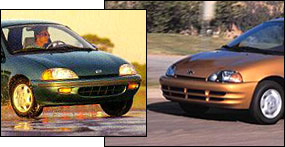
At the completion of the first part of my recent air filter test, I found myself at the far end of the stretch of highway I had been using for my test course. I was ready to head for home, but not wanting to "waste" the opportunity to collect more data on the return leg, I decided to throw in a one-shot aerodynamic test, just for the fun of it. I chose a simple aerodynamic mod known as grille blocking, because it's quick and easy to set up. The results were surprising. Of course, not having planned for this, I didn't have any appropriate materials with me. So my methods were a little, um, creative (and probably influenced by having spent the previous night wallpapering the bathroom)... Papier mache grille block I scrounged a couple of pages of newspaper, slopped them through a roadside puddle, and plastered them across the front of the car. I covered about 90% of the grille openings. (It was just below freezing at the time, so air flow for cooling wasn't a worry.)
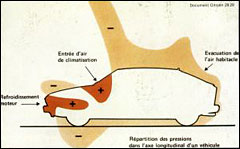
Now, the theory behind grille blocking is simple enough. A surprising portion of a vehicle's aerodynamic drag results from air passing through the grille, slamming into the radiator(s), swirling through the engine bay and then exiting beneath the car (only to re-join the turbulent flow past the high-drag structural, exhaust and suspension components). A study of a recently designed (i.e. contemporary aerodynamic) Volvo rated the "cooling package" (radiator, intercooler, oil cooler) as one of the the largest contributors to the vehicle's total drag, at a whopping 33.4% *. But never mind Volvo. Look no further than NASCAR! Well, NASCAR video games anyway. My brother-in-law-the-gamer will tell you that "grille tape" is a critical arrow in a race team's quiver to tweak the highest possible speed (aero efficiency) from a car (with the goal being to limit the amount of air entering the grille to the minimum amount necessary to keep the engine from melting!). Just Google nascar grille tape to see what I mean. In a nutshell, any air which isn't needed for cooling is aerodynamically much better off flowing around the outside of the vehicle. (It was also pointed out at the MaxMPG forum, that grille blocking may also increase the temperature of the engine and transaxle, and this aids efficiency as well.) So, with papier mache grille tape in place, I brought the car up to speed, resumed the cruise control (at the same speed as several of the filter runs, for comparison), reset the average fuel consumption function, and ...
3% more efficient Wow! After seeing practically insignificant differences between filter types, suddenly I'm looking at a whopping 3.1% improvement in fuel consumption - or 1.5 MPG (US) for my 3-cylinder Metro. All from sopping wet newspaper. At the end of the run I stopped to check how much of the aero mod had survived. Sure enough, a few chunks of wet paper had torn and been ingested through the grille openings. But approx. 75% of the coverage remained. Still, pretty impressive - and inspiring. Never mind fiddling with expensive air filters - aerodynamics is where it's at. So here we have yet more unfinished business. I'm looking forward to running some more organized tests ... though maybe next time I'll use duct tape. Continue to part 2 of this story. ---
* source: Modifying Under-Car Airflow - autospeed.com
darin AT metrompg D-O-T com, or here
|